We spend a lot of time debating AI's impact on research methodology. But I think we're missing the bigger transformation happening right under our noses.
Shein is showing us what the future looks like. And it's not "faster surveys". Here's what they've actually built:
The LATR Model (Large-scale Automated Test and Reorder)
Shein monitors realtime what is trendin on TikTok and other social media. When it's algorithms spot a design with potential, it commissions a small order from one of its factories... often just a few dozen pieces... which it then floats on its channels to see if consumers are interested. If they are, production scales up immediately.
The scale is staggering: Shein adds thousands and thousands of items per day to its app. Estimates suggest LATR generated about 20 times as many new items as H&M or Zara.
What makes it fascination to me is that this isn't just trend detection on Social Media (we've been able to do this for years already). It's a closed loop. The same system that measures demand also shapes it:
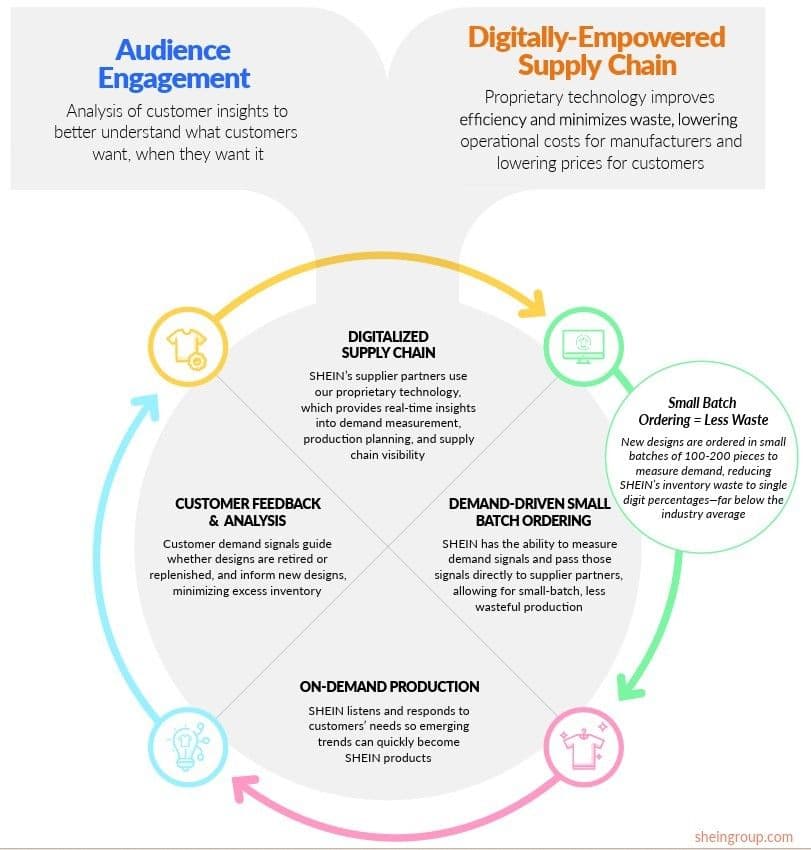
When Shein "discovers" a trend is working, they're actively amplifying it through algorithmic recommendations and influencer seeding. They're not passively observing organic demand. They uses data and algorithms to match consumer demand for designs to the capabilities of particular members of its manufacturing network, and keep close tabs on manufacturer performance as closely as it monitors customer preferences.
But it's not fully automated... and that's the part we should pay attention to.
Despite the AI-driven machinery, human judgment remains at critical chokepoints. For instance, human experts still translate trend-signals into actual products: case studies describe internal planning and design teams working from algorithmic trend data rather than traditional seasonal intuition. Suppliers submit designs that go through human approval before even small test batches are produced. And Shein monitors manufacturer performance closely... poor performers can be dropped from the network.
So where humans still matter most:
This reminds me of the O-Ring Theory I wrote about recently: in complex systems, human judgment at key steps protects against cascading quality failures. The AI handles volume and speed, but one bad decision at a chokepoint can contaminate everything downstream.
My interpretation: this is market research as the operating system.I'd call this anIntelOS... an Intelligence Operating System: what happens when consumer intelligence stops being a project you commission and becomes the continuous nervous system running the business. Sensing. Testing. Amplifying. Learning. Repeat.
The traditional research model: Insight → Report → Decision → Action (weeks/months)
The IntelOS model: Signal → Test → Amplify → Scale/Kill → Learn → Signal (days/weeks)
What does this mean for our industry?
So the question for ourselves is: are we building embedded intelligence capabilities and positioning ourselves at the critical human judgment points... or are we only focused on selling projects that sit outside the operational loop entirely?
NB 1:The above is based on whatever i could find in public sources both from Shein and external parties
NB 2.I admire what Shein is doing with their operating model. At the same time i don't like at all what Fast Fashion (Shein being the leader i guess...) is doing to our planet
SOURCES: